Small Towns, Big Truths: How Minor League Cities Became Unlikely Sanctuaries for LGBTQ+ Players
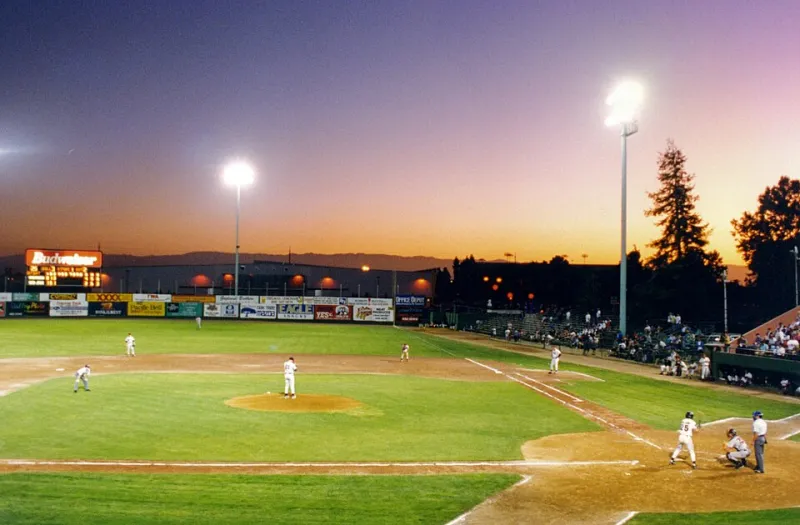
Photo: Rdikeman at English Wikipedia, CC BY-SA 3.0, via Wikimedia Commons
There's a version of the coming-out-in-baseball story that gets told a lot. It usually involves a major league clubhouse, a media firestorm, and a carefully worded statement released through a publicist. It's dramatic. It's visible. And for a lot of LGBTQ+ players grinding through the minor leagues, it feels about as relevant to their actual lives as a World Series ring.
Because here's the thing nobody really talks about: some of the most quietly affirming corners of professional baseball aren't in New York or Los Angeles or Chicago. They're in places like Midland, Texas. Hickory, North Carolina. Eugene, Oregon. Burlington, Vermont. Towns that don't trend on Twitter, don't have Pride districts, and don't show up in anyone's listicle of LGBTQ+-friendly cities — but that have, in ways both accidental and deeply intentional, become places where LGBTQ+ minor leaguers found something rare: the freedom to exhale.
The Paradox Nobody Predicted
It seems counterintuitive on its face. Smaller, more conservative-leaning communities offering more breathing room than major metros? But spend time talking to players who've moved through the minors and a consistent picture starts to emerge.
The minor leagues operate at a different pace. The scrutiny is lower. The media infrastructure is thinner. There are no beat writers camped outside the clubhouse door waiting for a quote, no social media armies dissecting every at-bat. And in that relative quiet, something unexpected grows: the space to just be a ballplayer — and a person — without the performance of it all.
One outfielder who spent four seasons bouncing between Single-A and Double-A affiliates in the Southeast described his time in a small Carolina mill town as the first place he ever felt like his teammates actually knew him. "In high school, in college, I was always managing what people saw," he said. "But in that clubhouse, I don't know — we were all just broke and tired and trying to stay in the game. Nobody had the energy to care about who I was going home to."
That exhaustion-born pragmatism turns out to be its own kind of grace.
The Closeness That Changes Things
Minor league rosters are intimate in a way the majors simply aren't. You're sharing cramped buses for six-hour drives through flat midwestern darkness. You're splitting a two-bedroom apartment with three other guys because the per diem doesn't stretch far enough for anything better. You eat together, lose together, and sit through rain delays together in towns where the next nearest entertainment option is a Dairy Queen off the interstate.
That forced proximity, players say, does something to the walls people put up.
"When you're that close to people for that long, you either hate each other or you actually become a family," said one pitcher who came out to his Double-A teammates in a mid-sized Midwest city during his second professional season. "I didn't make some big announcement. I just... stopped hiding. And most of those guys, they'd already figured it out. They just hadn't said anything because they were waiting for me."
He laughs telling the story now. His team went on a seven-game winning streak after the conversation. He's convinced it wasn't a coincidence.
The Towns Themselves
It would be too easy — and frankly a little condescending — to frame this story as LGBTQ+ players finding tolerance despite their small-town surroundings. The reality is more layered than that.
Some of these communities have been more intentional than they get credit for. Minor league front offices in smaller markets often run tighter, more community-embedded operations than their big-league counterparts. The front office staff knows the players by name. The team is genuinely woven into the social fabric of the town. And in more than a few cases, that familiarity has created organizational cultures that reflect the values of the people running them — people who, it turns out, just want good baseball and good humans in their building.
A former front office manager in a mid-Atlantic short-season league talked about making quiet but deliberate choices: inclusive language in team communications, no tolerance for slurs in the clubhouse, and a standing policy that players' partners — regardless of gender — were always welcome at team events. "We never made it a press release," she said. "We just did it. And I think that's actually why it worked."
That low-key approach resonates deeply with players who've grown wary of performative inclusion. Rainbow-logo jersey nights are fine. But a manager who pulls you aside before your first road trip and says, without fanfare, "Whoever you are, you're part of this team" — that lands differently.
What Gets Left Behind When You Move Up
Here's the part of the story that stings a little: for some players, the climb toward the majors has meant leaving behind the most authentic baseball environment they ever experienced.
The higher the level, the more the scrutiny returns. The media presence intensifies. The stakes get larger. The unwritten rules calcify. And players who spent two or three years living relatively openly in the minors find themselves recalibrating, pulling back, re-managing their visibility in ways they thought they'd moved past.
"I was more out in [a small Southern league city] than I've been since," one player admitted, now several years into an upper-level career. "That sounds like it should be sad, but I don't know — I carry that time with me. I know what it feels like to just play ball and be myself. I know it's possible. That matters."
It does matter. Because those minor league years aren't just a developmental runway to the majors — they're formative in every sense. The players who found themselves in overlooked towns and underestimated clubhouses didn't just get better at baseball. They got better at being themselves. And that's a kind of progress that doesn't show up in any stat line, but it shows up everywhere else.
The Quiet Revolution Nobody's Crediting
The conversation around LGBTQ+ inclusion in baseball tends to orbit the highest-profile moments: the first openly gay major leaguer, the biggest Pride nights, the loudest allies. And those moments matter — genuinely.
But the ground-level transformation happening in Single-A clubhouses in Kannapolis and Quad Cities and Fresno? That deserves its own chapter. It's messier and quieter and less photogenic than a Pride flag over Camden Yards. But it might be doing more actual work.
Because that's where the culture gets built. Not in press conferences. In bus rides. In shared apartments. In the small, unremarkable moments when a teammate says something kind, or a manager sets a tone, or a player stops hiding and the sky doesn't fall.
The diamond, it turns out, doesn't only shine under the bright lights. Sometimes it glints most honestly in the places nobody's watching.